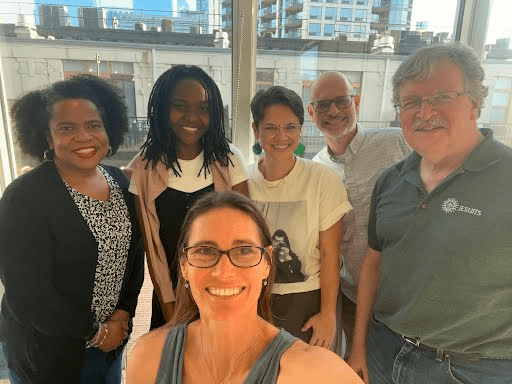
What a fascinating and generative discussion I had this weekend in Chicago with Drs. Bill Clark (Holy Cross), Brett Hoover (Loyola Marymount), Tia Pratt (Villanova), and Susan Reynolds (Candler/Emory) and student Gaby (Northwestern). We enjoyed a deep dive into one another’s research; so many brilliant questions to illuminate both research and applied insights! This Parish Researchers Gathering was part of the National Conversation on Shared Parish Life, generously funded by an anonymous donor. I look forward to the ways this research and our ongoing conversations will strengthen parish life and the American Catholic experience more broadly.
I’m so happy to announce that I am working with Liturgical Press on a book that explores the beliefs, practices and ministerial possibilities for engaging Catholics who attend Mass infrequently. The working title is Cultural Catholics: Who They Are, How to Respond and will use the most recent wave of the American Catholic Laity survey. In analyzing the self-reported attitudes and behaviors of over 1500 Catholics, this book allows us to compare the 53 percent of American Catholics who attend Mass “a few times a year” or less often with more regular Mass attenders, offering ministerial insights for reaching out to Catholics who are less engaged with parish life.
This book will explore how cultural Catholics understand and enact their Catholic identity, their political and civic beliefs, their experiences in parish life and thoughts on Church leadership. It is geared primarily for parish, campus and diocesan leaders who want to cast a wider net in their accompaniment and ministerial offerings and will likely be a useful read for a variety of ecclesial leaders.
The American Catholic Laity Study team is happy to share that we have a contract for our book with NYU Press. This is the sixth book in the series of surveys that William D’Antonio started in the late eighties. This round we are also incorporating interviews with about 60 Catholic leaders (e.g., bishops, employees at the USCCB, public influencers, leaders of lay apostolates, etc.). Drs. William D’Antonio, Michele Dillon, and Mary Gautier oversaw the survey aspect of the research and Drs. James Cavendish, Paul Perl and I are taking the lead in the interviews. We’re quite far along in the writing process and will have a manuscript–tentatively titled Catholicism’s Crossroads: The Present and Future of America’s Largest Church–to NYU Press by January… probably sooner. The six main themes of the book are Church, authority, race, citizenship, sex and family, and future.
We’re unearthing some great insights for both scholars and Catholic leaders… really for religious leaders broadly as many of the challenges Catholicism faces are not unique to Catholicism. Stay tuned for updates!
I just wanted to update you that elections for the Religious Research Association closed yesterday and I’m happy to announce that I was elected to serve on the Nominating Committee. In this role I’ll help make sure that our organization puts forth quality candidates that not only excel in our field, but also represent the breadth of our membership in racial and ethnic diversity, gender, denominational focus and more so we can ensure that our leadership is amazing and represents the many concerns and perspectives of our members.
I have benefitted so much from the “and how can we apply our research” focus of RRA and look forward to giving back in this capacity.
I’m more than a little excited to be partnering with the University of Southern California’s Center for Religion and Civic Culture! This center does some amazing work examining the intersection of religion, civic engagement, social change, personal and institutional thriving and more. I’ll be working with them on a variety of projects that connect to Catholicism, from Catholic sisters to formation to climate change. It’s an exciting collaboration that will include a trip to London and Oxford at the end of the month to meet with similar organizations and scholars and explore international collaborative opportunities. This will be my first trip to the UK and I’m thrilled to help make this important work happen.
Spring is here and along with the blossoms comes the Spring issue of The Way. Here you’ll find my latest contribution, “Franciscan Roots of American Catholic Social Justice Ministry.” It shows the way American social ministry was informed–wittingly or not–by key elements from the Franciscan Tradition: transformation, Christ, community, mercy, compassion, and gift. I hope it gives you some thoughts and inspiration for bringing some healing to our world!
I just got word that I will be one of a dozen or so researchers who will continue to analyze the data from the National Study of Catholic Priests, housed at The Catholic Project at the Catholic University of America! My project, tentatively titled “The Impact of Relationships with Bishops and Priests on Priestly Satisfaction: A Qualitative Analysis,” will explore the relationship between priests’ priestly satisfaction and their sense of connection to their bishop (or religious superior) as well as their fellow priests (or religious community). It is a fantastic dataset and I’m looking forward to discovering ways we might better support priests and, by extension, the whole Church. In addition to all this good stuff, I’m also excited that this research fellowship has collaborative components… looking forward to connecting, exchanging ideas, and laughing together!
Today was the day for myself and the eleven other fellows to submit our cases to the awesome folks at VU’s Center for Church Management.
The twelve case studies are meant to help alleviate financial pressures that hinder pastors’ ability to effectively lead their congregations. One of the ways the Center for Church Management chose to contribute here is to compile twelve different case studies (and supplemental teaching material) that will be used in their program as well as in other seminaries and business schools. For now these will be “in house” but if these become published as a text, I’ll let you know!
Thank you to the Center for Church Management for their consistently collaborative and professional approach and to the Lilly Endowment’s National Initiative to Address Economic Challenges Facing Pastoral Leaders for funding this important work!
Some of my research on Catholics and political commitment was featured in the Winter 2023 issue of The CARA Report. “Nuances in Support of Catholic Causes” highlights that the polarization gap closes–and for some issues, disappears altogether–as commitment to Catholicism increases.
I broke our sample of 1500 Catholics into those who identified as Democrat or Republican, and then also broke those folks down by whether they were high commitment, medium commitment or low commitment Catholics (“commitment” is a composite variable based on Mass attendance, likelihood of leaving the Catholic Church and how personally important the Catholic Church is to them). I found that, when asked about government funded health insurance, supporting migrating families, and opposing the death penalty–all “Democrat-friendly” issues–both Democrats and Republicans became increasingly supportive of the Catholic position as their Catholic commitment increases (this is less noticeable for Democrats on the health insurance and migration issues, where we’re approaching saturation with the support). On the death penalty issue, the high commitment Catholic support among Republicans was so strong that they actually surpassed the low commitment Democrats! At least more than half of high commitment Catholic Republicans defected from their party and selected the Catholic position for these three issues.
These data show that while the majority of Catholics tend to vote through the thinking of their party, the high commitment Catholics will also consider their faith, so much so that they will break with the party lines. The polarization narrative is not as cut and dry as we often make it out to be (thank goodness!).
All this and more will be featured in a book that Jim Cavendish, Paul Perl and Michele Dillon and I are writing up right now, so stay tuned. Thank you, CARA, for helping our research find its way into the hands of ministers and Catholic leaders who will apply this to their ministries.
This month a new commission I am a part of–The Commission for Affective Maturity, Order of Friars Minor–had our first meeting. It is a very international and interdisciplinary group, with five people across four continents. Needless to say, it was impossible to find a convenient time for everyone to meet (it was 6am my time!). But, time zone challenges aside, we are excited to be taking on some very important work.
The Order of Friars Minor has commissioned us to write a document on affective maturity. It will be roughly a two year process, and will result in a valuable and practical document. The final document (as we envision it at this stage) will assess socio-emotional maturity as well as provide guidance to help people further mature. I am very pleased to join the following practitioners and scholars in this endeavor:
Br. Darko Tepert, a Franciscan and Scripture scholar from Rome (chair)
Ms. Ann Yeong, an expert in spiritual formation from Singapore
Br. Daniel Alejandro Fleitas Zeni, a Franciscan and psychologist from Argentina
Br. Alessandro Ciamei, a Franciscan and therapist from Rome
It is still early in our project, but in our multilingual and multicultural context, we are generating some good ideas… even at 6am!